This post may contain affiliate links. If you buy thru these links, we may earn a commission at no additional cost to you.
TL;DR – Halloween Dog Safety & DIY at a Glance
The Challenge: Dogs perceive Halloween costumes, masks, and constant doorbells as unpredictable environmental threats, triggers for their anxiety, and potential bite causes.
The No-Sew DIY Strategy: You don’t need a sewing machine to make a comfortable costume. Use child-sized socks, soft cotton t-shirts, and elastic bands to ensure your dog’s comfort.
The 2026 Reality Check: With the explosion of Xylitol (aka Birch Sugar) in everyday chewing gums, mints, and baked goods… keeping human loot separate from dog treats is your #1 defense against emergency vet visits.
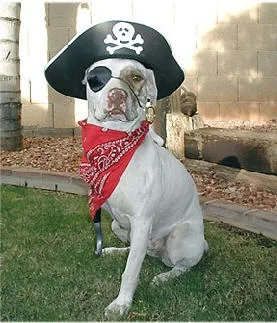
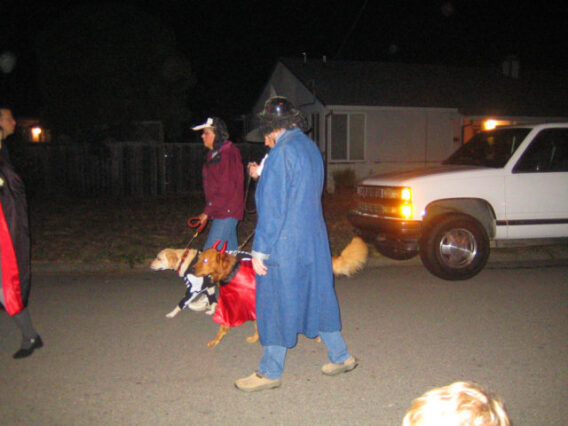
Are you planning to participate in a pet parade with your dog?
Maybe you’ll be entering a pet Halloween costume contest this year.
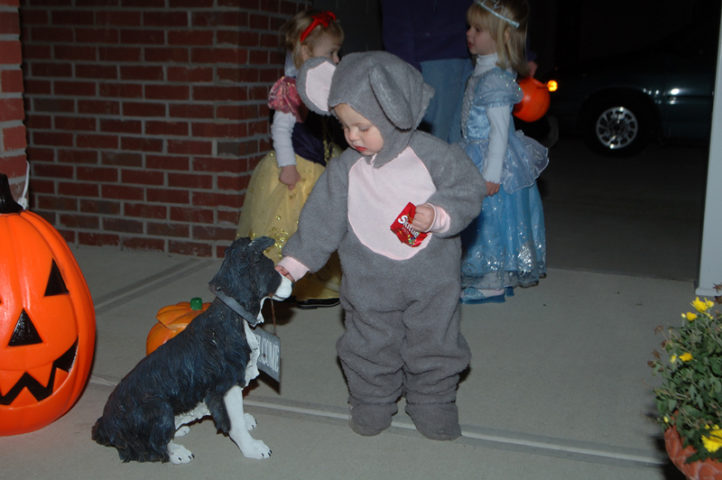
Or perhaps you’re just thinking of taking your dog “trick or treating” with you.
Inside This Guide
4 Steps To Get Your Dog Used To Wearing A Costume
Easy DIY Halloween Costume Ideas for Dogs
Easy No-Sew “Dog Walker” Costume for Humans
Low-Stress Costume Alternatives for Dogs
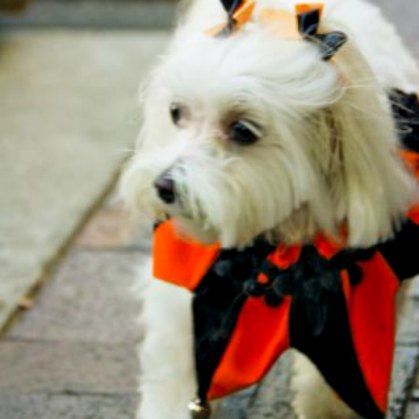
8 Ways to Keep Your Dog Safe & Happy In Their Costume
My Halloween Night Timeline to Keep Your Pup Calm at Home
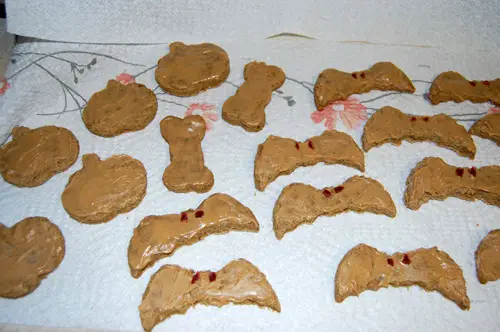
My Go-To Homemade Pumpkin Dog Treat Recipes
Take it from someone who’s been through the highs and lows of involving my own dogs in Halloween activities…
You’ll want to make sure that your dog doesn’t mind being dressed up way ahead of time!
Trying to get a dog to wear a Halloween costume (or ANY clothes for that matter) can sometimes be tricky.
Your dog may not like the feeling of wearing a strange, bulky outfit. And some dogs don’t like having anything on their back OR on their face at all!
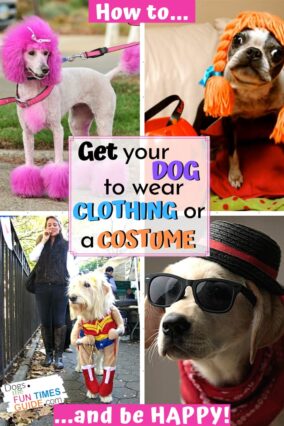
Here’s how to get your dog to wear clothes or costumes…
4 Steps To Ease Your Dog Into Wearing A Costume
STEP #1: See & Smell
At the very least, you’ll want to do a “dress rehearsal” several days ahead of time.
Start by introducing the item of clothing (or costume) to your dog 2 to 3 weeks ahead of time. Allow your dog to feel it and smell it. Leave it sitting out (while you’re at home) — so they can get used to the sight and smell of it.
Your first step is to simply get your dog used to wearing something on their head / face.
Start with some very basic items — like a hat, sunglasses, or hair ribbons.
Don’t go out and buy these things. Experiment with your own items — because you’re simply trying to get your dog used to having things on him for short periods of time. You’ll be watching your dog closely the entire time, so there’s no risk of your dog damaging them.
Again, look for even the smallest opportunities to give your dog a treat and lots of praise for keeping the items on for very short bits of time.
STEP #3: Body
Next, try a t-shirt (either a dog-sized shirt or a small child’s shirt) OR a pair of shorts (again, made just for dogs or a child’s pair).
This will determine how comfortable your dog is wearing something ON their body.
For some dogs, anything at all is too confining. For others, some items are no big deal.
Continue to give treats and lots of praise even for very short periods of sitting still with the item on. Gradually increase to bigger treats AND more of them for every little bit of improvement your dog makes toward keeping the item on without pawing at it, biting it, or running away.
STEP #4: Feet
Finally, depending on how far you want to take it (or what’s included with your dog’s costume), it’s time to see how comfortable your dog is having something on their feet.
Dog boots (or booties) take extra time for most dogs to get used to.
That’s why I recommend getting your dog used to wearing a soft, comfortable pair of child’s socks before trying any “official” dog footwear — which is likely to be tight-fitting and somewhat confining.
My dog Tenor is pretty easy-going and he will sit through just about anything you put him through — from trimming nails and brushing teeth to wearing hats and sunglasses. But… the dog boots we bought for him to wear in the winter definitely took the most time to get used to. It was a gradual success, rather than an overnight success.
My best tip for dog footwear is to put them on just the front paws OR just the back paws first. That way, your dog will still have full control and normal feeling on the other two paws.
One of my dogs (Destin) did fine when we went all out and put toddler socks on all 4 paws at once. The first time I tried putting winter boots on Destin, he did the classic high-step freeze. I learned that putting child socks on just the back paws first let him maintain tactile control of his front paws — which reduced his panic.
My other dog (Tenor) took much longer getting used to having something on his feet. Truthfully, he never comfortably adapted to it. He simply learned to “put up with it”.
The Bottom Line:
Depending on the dog, it could take anywhere from 1 day to many weeks of trying to get your dog comfortable with wearing items on their head, face, body, and feet. If you find that your dog just doesn’t like wearing clothes, then don’t force your dog to wear them! That will just stress out your dog… and lead to other problems.
Still Trying To Get Your Dog To Wear A Halloween Costume?
As long as you use positive reinforcement AND you’ve already experimented with the simple items mentioned above first, then you should be able to get your dog to wear a Halloween costume in no time!
As with ANY item of clothing, it could take several days or several weeks before your dog is comfortable with wearing a costume. It all depends on the dog.
Please… If your dog just doesn’t like wearing the costume you bought or made for them, don’t force your dog to wear it. Doing so will really stress out your dog and won’t be fun for anybody — you, the dog, or the people and dogs around you.
The Goal: Create a comfortable, lightweight “puppy” costume using your own clothing items and NO sewing machine
Time Required: 15–20 minutes
Skill Level: Absolute Beginner (No-Sew)
Why I Like It: This is my all-time favorite EASY costume for dog owners — because it shows how much you love dogs AND there’s no need to buy anything. Just use clothing items you probably already have! It’s super cute as part of a “dog walker” costume — where the big dog (you) is walking the little dog (your dog).
Supplies Needed
Don’t buy anything new, just grab these everyday clothing staples:
Base Clothing: 1 brown hooded sweatshirt and 1 pair of brown pants. (You could substitute black clothes with gold socks, or brown clothes with white socks.)
The Extremities: 3 pairs of beige (or brown) socks… for a total of 6 socks.
Fasteners: 1 box of heavy-duty safety pins OR an upholstery fabric stapler / nail gun.
The Core Form: A handful of soft cotton rags OR scrap fabric to use as tail stuffing.
Step-by-Step No-Sew Assembly Guide
Step 1: Make the Floppy Ears
Take your brown hooded sweatshirt and lay the hood flat. Take 2 of the beige socks (one for each side of the hood), and position them on either side of the hood opening — where a dog’s ears naturally flop. Use a heavy-duty safety pin from the inside of the hood fabric to secure the sock cuff. (This hides the pin completely and ensures there are no sharp edges touching your face.)
Step 2: Build the No-Sew Stuffed Tail
To build a sturdy, realistic tail, take 1 beige sock and roll it tightly into a tube shape. Stuff this rolled sock entirely inside of a second beige sock — to create a thick, plush form. Locate the lower back hem of the sweatshirt. Securely pin the open end of the stuffed tail sock to the middle of the back waistband.
Step 3: Paw Covers for Your Hands & Feet
The final structural layer uses the remaining 2 pairs of socks to cover your hands and feet.
Check out this video tutorial to see how to make a really cute puppy dog face with makeup:
8 Fun Alternatives For Non-Costume Wearing Dogs
If you’ve determined that your dog does NOT like wearing a full-on Halloween costume, all is not lost.
Check out these 8 no-stress alternatives…
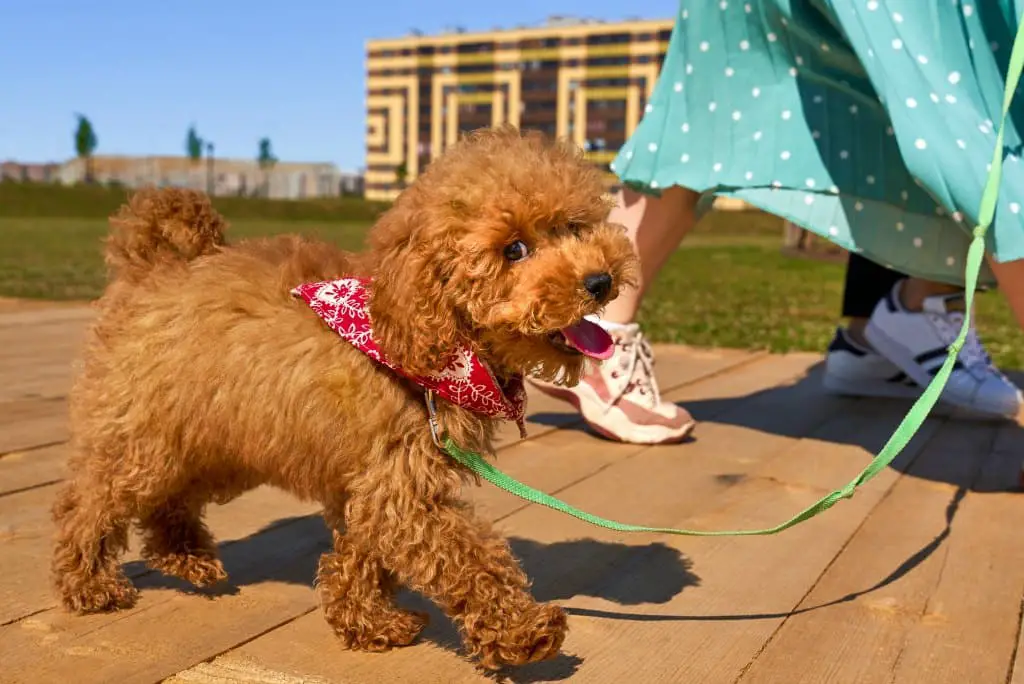
#1 –Dog bandanas – Not all of them must be folded & tied. Some are actual dog collars, so they’re less restricting and feel like your dog’s own collar. Others can be worn on the head (like a scarf).
#2 –Halloween dog collars – These have fun decorations and sayings specifically about Halloween. Again, most dogs are used to having collars around the neck area.
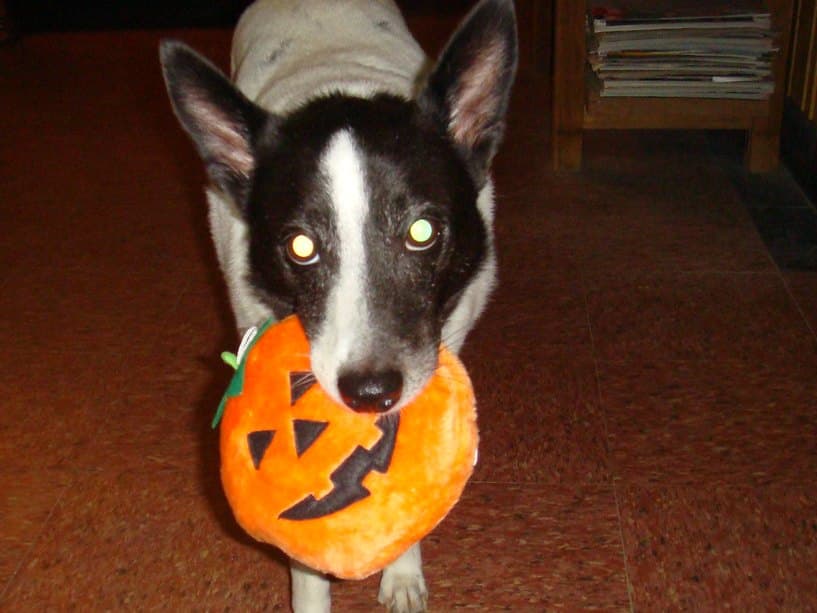
#3 –Dog Halloween toys – Maybe your dog will carry one around, or you could just carry them in your arms with your dog or place them in your dog’s stroller.
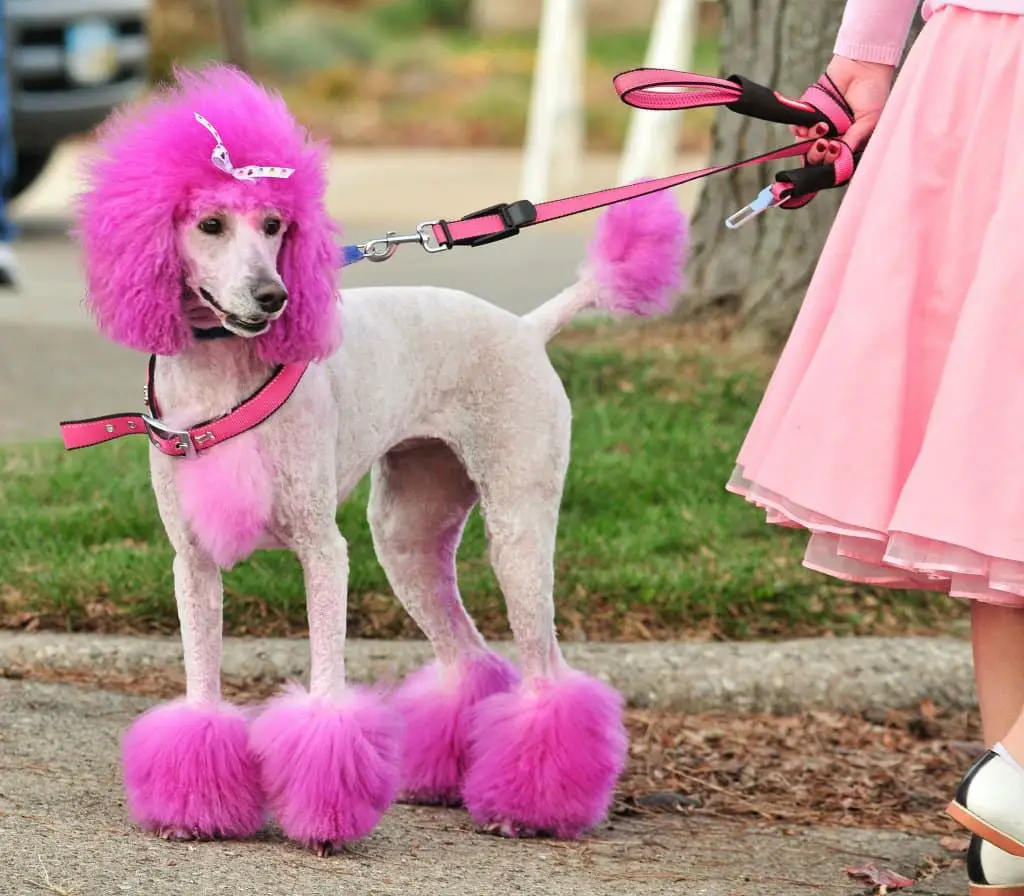
#4 –Dog hair dye – It’s a simple way to change your dog’s overall look. Orange dog hair dye would be good for Halloween, but it’s not the only color. For example, pink dog dye and green dog dye would look great on the right dogs! Plus, you don’t have to dye all of your dog’s fur… maybe just some highlights would be fun. (Or, for a spa day Halloween costume, just put rollers in your dog’s hair!)
#5 –Neck accessories for dogs – Hung loosely around your dog’s neck, the right combination of items could make a unique look or statement. But don’t take your eyes off your dog while wearing the bling — because those items could strangle your dog if they get caught on something (like Tenor’s chain collar did one time).
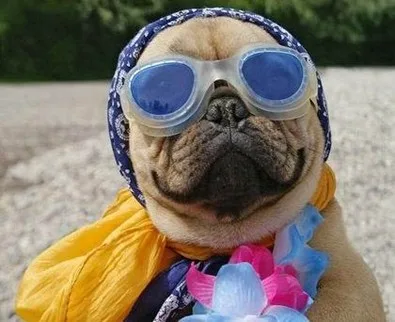
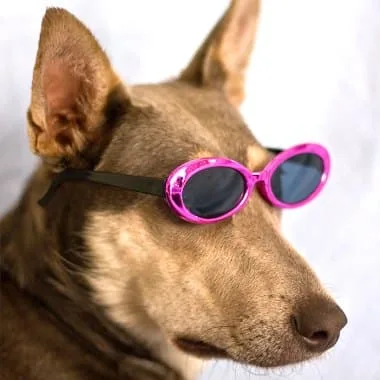
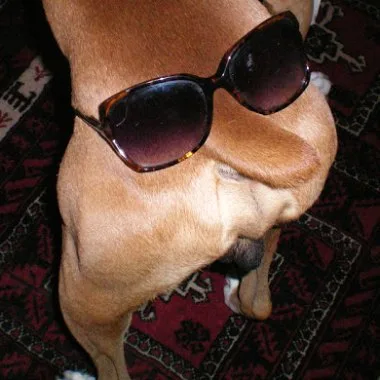
#6 –Sunglasses or doggles – You can experiment to see where your dog tolerates wearing them best: over his eyes, or over his tail!
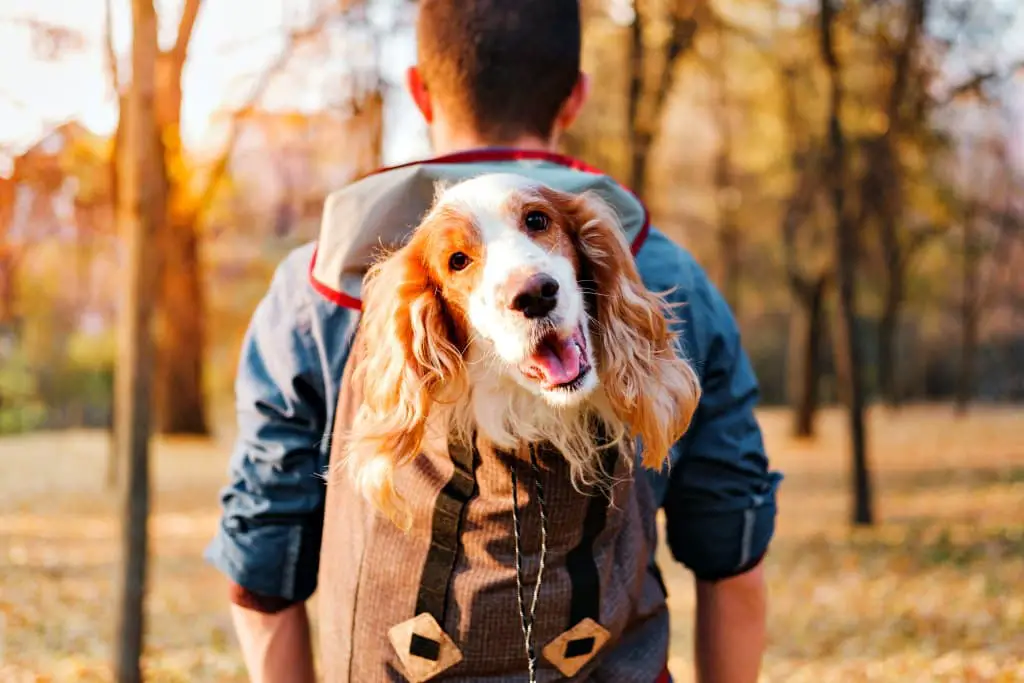
#7 –Backpacks & tote bags – If your dog is more comfortable being carried than walking, then you could dress up as a hiker and tote your dog around in a hiking backpack! Or, carry your dog around like Toto in a basket from the Wizard of Oz.
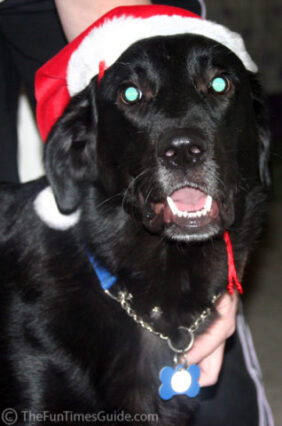
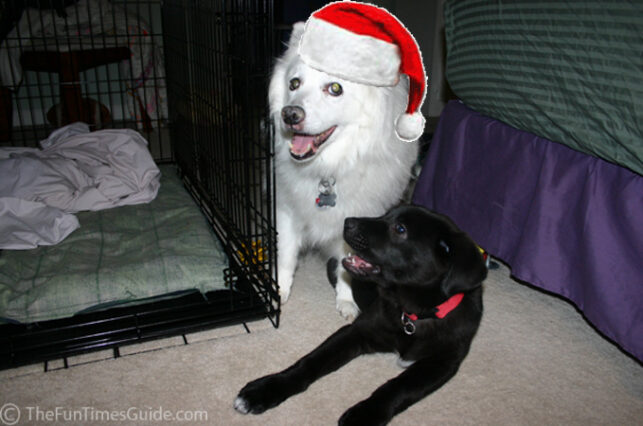
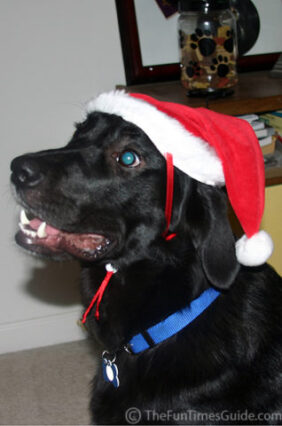
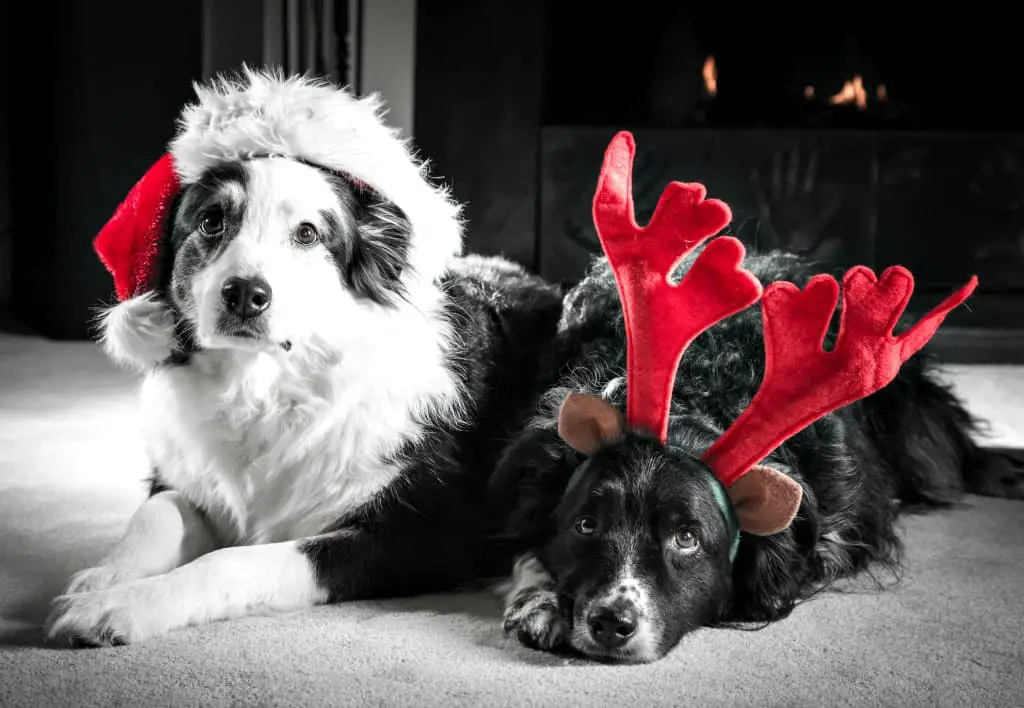
#8 –Hats, headbands, other headwear – My best tip if your dog doesn’t like wearing costumes is to keep practicing with a basic dog Santa hat. It’s simple. It’s festive. And while your dog may not win any pet costume contests, once your dog gets accustomed to wearing it, you can get 2 holidays of use from it — Christmas and Halloween! There’s nothing wrong with a dog going as a simple Santa Claus (or would that be Santa Paws?) for Halloween. My dogs Tenor and Jersey did one year:
TIP: If you can’t get a Santa hat to stay on your dog’s head, try a smaller hat with less material to flop around. Or, add your own thicker elastic band to secure it in place. You could also make your own dog Santa hat with a thicker neck band than usual — so it will stay in place comfortably. Or just go with a pair of headband antlers instead. (Headbands tend to stay on a dog’s head much better.)
Keep Your Dog SAFE (And HAPPY!) In Their Costume
Now, since pets wearing costumes poses some unique safety issues (both for you and your dog), here are 8 important things that you’ll want to think about before heading out the door with your dog in costume:
Use your best judgment as to whether your dog will wear a costumeand be comfortable in groups — or whether it will freak your dog out. You will know this better than anyone else. Only you know how your dog reacts around other dogs, kids, and strangers. If your dog isn’t comfortable in loud groups, then you may want to think twice about entering him in a parade or costume contest. Without a doubt, you need to make sure that you always have adequate control of your dog during the times when he is close to other dogs and people.
Make sure that you will be able to maintain control of your dog at all times when he’s in the costume — just like you do when you’re on a regular walk. That means being able to attach his regular leash and/or harness while the costume is on.
Don’t leave home without your dog wearing a collar and ID tags — you never know what might arise when you’re out & about. If your dog should get separated from you for some reason, his ID tags will be the only way to ensure that your dog finds his way back to you.
Make sure your dog’s Halloween costume doesn’t have any parts to it that could accidentally bind him or cause him to get caught up in or trip over. Just the same, remove any parts that he could choke on or that might be poisonous to your dog if he swallowed them.
It gets hot inside costumes — so you will need to find ways to prevent your dog from overheating inside the dog Halloween costume that you pick. Make sure it’s not too tight on him, that there is plenty of room to breathe, and that he’s not panting too much.
Make sure that your dog is highly visible — because not everyone will expect to see a 2-foot gobblin walking next to you. If there’s any chance of it getting dark while your dog is out & about in costume, then use a reflective leash and/or dog collar. They also make reflective leg bands and bandanas for dogs. Or, you could attach a blinking light to your dog’s collar to make him more visible at night.
Keep your dog from becoming thirsty — because he will probably be walking more than usual. Since you probably don’t know exactly how long the day’s events will last, be sure to take along a water bottle for your dog to ensure that he never becomes dehydrated.
Don’t allow your dog to eat things found on the ground or eat treats received from strangers — at least not until you get home. Many people don’t realize that chocolate is bad for dogs. So is Xylitol — it’s found in sugarless gum and candies (often listed as “Birch sugar”). Besides, if your dog doesn’t normally eat human foods at home, then you don’t want him to get them when he’s out & about either.
How Much Fun Is Halloween For Dogs?
Dog stress is a serious issue. You don’t want your dog to be stressed during Halloween, right?
Here are 8 things you MUST DO in order to keep your dog safe and happy at home on Halloween night…
Does your dog always bark at the doorbell? Halloween is a great time for dog doorbell training!
Of course, you wouldn’t want your dog to become ill or injured due to your own negligence. Your dog is part of your family and you are his pack. He trusts you to keep him safe.
What I do with my dog every Halloween:
#1 – In the afternoon, I treat my dogs to a long walk, a day at the dog park, or a long car ride. These are the types of activities that literally wear my dogs out. They’ll usually sleep for a long time afterwards.
If you’re not able to take your dog on a vigorous walk, then play catch for a while with your dog… or try some new enrichment activities.
#2 – Right after dinner, I take my dog out to pee and poop BEFORE all the spooks and ghouls begin constantly ringing the doorbell.
A few minutes before you expect the first trick-or-treaters to arrive, decide if your dog will have free roam of the house (and the frequently opening front door) — or not.
Either put your dog in a separate room — away from the front door. You might even want to put some tennis balls in the clothes dryer and turn the dryer ON. (The noise may be just enough to distract your dog from the noises at the front door.)
Or attach your dog to you using a waist leash. That way, your hands will be free to hand out candy (and control your dog if necessary) AND your dog will only have a limited amount of space to move toward strangers.
#3 – Since strangers in spooky costumes will be coming to your door for hours, keep an eye on your dog to gauge how they’re handling all of the commotion.
#4 – If your eyes aren’t going to be locked on your dog the entire time, be aware that any open door (that’s been accidentally left open OR can be “pushed” open) gives your dog an opportunity to escape. The SPCA reports that the day after Halloween is the busiest day for lost dogs and cats to arrive at the shelters.
#5 –Keep all forms of candy (especially chocolate) out of your dog’s reach. Dogs don’t have the stomach enzymes to digest such foods. The amount of chocolate that’s dangerous depends on the size of your dog.
Watch your kids! Children may make the harmful mistake of sharing their loot. Make sure they know the difference between a treat for them and a treat for their four-legged friends. Keep the 24-hour ASPCA Animal Poison Control Center hotline handy: 888-426-4435. If you suspect your pet has eaten something that’s bad for them, call your veterinarian or the Poison Control Center immediately. ~Humane World for Animals
#6 –Don’t send your dog out trick-or-treating with your kids. That’s a parent’s job, not a child’s job. Young children aren’t capable of caring for a dog when spooky ghosts and goblins are flooding the streets. Even teens can become too easily distracted on such a fun night out.
Since there is so much going on during Halloween (from laughing children and crying babies to loud doorbells and scary Halloween decorations), dogs can react in ways that they never have before. If your dog gets loose and becomes confused, frightened, or disoriented… he may even bite someone out of fear.
#7 – For the reasons I mentioned above, think twice before dressing your dog in a pet Halloween costume. They are often uncomfortable for dogs.
Plus, elastic and ribbons can become twisted in the dog’s fur and cause swelling. Not to mention the fact that some dogs decide to chew on the costume, and may actually ingest parts of it.
#8 – While my house is generally puppy-proofed at all times, I STILL make a point to walk around all of the decorations that have been set out specifically for Halloween.
Things like streamers and spider web decorations, if ingested, can seriously block or pinch off a dog’s intestines.
Don’t overlook all of the extension cords you’re using for decorations inside and outside either. A dog chewing on electrical cords can become electrocuted.
If you use candles and/or votives on Halloween night, be sure to keep all of the lighted candles of “tail range”. A swiping dog tail could easily knock a candle over and start a fire. A very excited pup can roll over a pumpkin that has a lit candle inside…. sending the candle flying and lighting everything in its path.
Halloween Treat Recipes For Dogs
On Halloween this year, you are likely to see some four-legged trick-or-treaters among all the children.
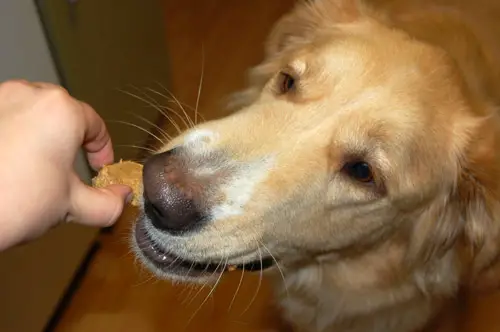
Since more people are taking their dogs trick-or-treating with them these days, why not have a separate bowl of HOMEMADE dog biscuits at the door — next to the bowl of candy for the children?
Whether you give four-legged trick-or-treaters ‘regular’ dog biscuits this Halloween or special homemade ones, you’ll need to decide in advance how you will give them to the dogs.
Some ideas:
Give the dog biscuit directly to the dog owner to give to their dog now. This is the easiest option, since no extra planning is needed.
Wrap a dog biscuit in a small Halloween decorated bag and hand it to the dog owner to give to the dog later. If you made the dog treats yourself, consider including the actual recipe. You’ll make the dog owner’s day!
Place a Halloween dog treat in a see-thru snack-size baggie. That way, it’s obvious to the dog owner (and the children) that this treat is intended for dogs. With the right markers or paints, you could make small Halloween decorations right on the plastic baggie for a simple, fun touch.
The Bottom Line
It’s up to YOU to do everything you can to keep your dog safe this Halloween.
I hope that everyone who sees this decides to use the tips in this article (and your own common sense) to ensure that you and your dog have a safe and happy Halloween!
Because you can never be too prepared…
Like this post? Save it to read again later… or share with others on Pinterest!
I like to help Dog Parents find unique ways to do things that will save time & money — so I write about “outside the box” Dog Tips and Dog Hacks that most wouldn’t think of.
I’m a lifelong dog owner — currently have 2 mixed breed Golden Aussies that we found abandoned on the side of the road as puppies. I’ve always trained my own dogs and help friends train theirs, as well. Professionally, I worked at a vet and have several friends who are veterinarians — whom I consult with regularly. (And just because I love animals so much, I also worked at a Zoo for awhile!) I’ve been sharing my best ideas with others by blogging full-time since 1998 (the same year that Google started… and before the days of Facebook and YouTube).
My daily motivation is to help first-time dog owners be better prepared from the first day your new puppy enters your home. I like to help dog owners understand what’s ‘normal’ and what you can expect in terms of living with and training your dog — how to get through the ups & downs of potty training, chewing, teaching commands, getting your dog to listen, and everything else that takes place during that hectic first year!
When I’m not training, walking, grooming, or making homemade treats for my dogs, you will find me at the corner of Good News & Fun Times as publisher of The Fun Times Guide (32 fun & helpful websites). To date, I’ve written over 600 articles for dog owners on this site! Many of them have upwards of 200K shares.