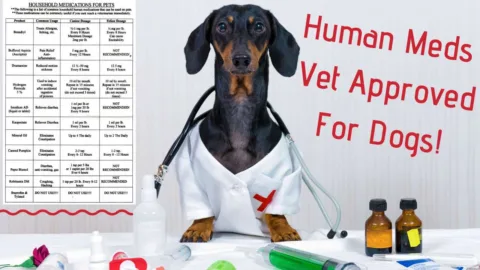

I received an email the other day from “Joyce” who thought I had printed the wrong dosage for Imodium and dogs in this article about dog medications safe for dog diarrhea.
Panicked, I rushed to double-check right away, and found that I had NOT listed the wrong dose… Whew!
Her confusion lies in the fact that I (correctly) mentioned the dosage for that liquid medication in milliliters (ml). Other sites — including a site I actually linked to in that article — might mention the dosage for that same medication in solid form (pills, tablets, or capsules) in milligrams (mg). Please see the new “important note” about Imodium below.
Doses For Liquid vs. Solid Dog Medications
For some reason, my dogs have always been more receptive to liquid forms of medicine, rather than pills.
No matter what I try to “hide” the pill in, they find it and spit it right out.
But with liquid meds, I just mix it in cottage cheese (which they rarely get, so they think it’s a special treat …or sometimes I even mix it in their own dog food gravy) and they never even know it’s there!
UPDATE: I finally figured out how to give a dog a pill — which is much easier than the way I used to do it (when I only had a 50/50 success rate).
Which brings to light the fact that it’s imperative to closely double-check dosing information before dispensing any human medications to your pets.
While there rarely is a difference in the effectiveness of liquid vs solid medications, there is a huge difference in doses if you happened to mistake mg’s (milligrams / weight) for ml’s (milliliters / volume).
Here’s a great online Vet Conversion Calculator for measuring things for your dog by volume or by weight.
List Of Acceptable Human Meds Vet Approved
The following Acceptable Household Medications For Pets chart came directly from my veterinarian.
This list has been a lifesaver for me! It has saved me lots of unnecessary trips to the vet — when I could simply provide dog-friendly doses of over-the-counter medications that we already had on hand.
One of the human meds for dogs we use most frequently in our household is Benadryl.
By the way, sometimes it’s easier to give the liquid form of safe dog medications instead of the pill form. However, when I asked my vet for the liquid dosage specifically for Benadryl, she said to always give a dog the pill form of Benadryl instead! Otherwise, you would have to give way too much of it from a bottle and it wouldn’t be cost-effective — especially if you have a large dog.
IMPORTANT NOTE: Before giving your dog Imodium, please see the updated pet dosage information from a veterinarian! (The correct dosage for Imodium pills is 0.5 mg per 10 lbs of dog weight up to 3x daily — Or, for a 40 lb dog, give one 2 mg tablet up to 3x daily.)
Now onto the lists of acceptable household medications for pets that I got from my veterinarian…
The Household Medications For Pets chart I got from my vet in the Summer of 2004:
**The following is a list of common household human medications that can be used on pets.
**These medications can be extremely useful if you can’t reach a veterinarian immediately.
| Product | Common Usage | Canine Dosage | Feline Dosage |
|---|---|---|---|
| Benadryl | Treats allergies, itching, etc. | 0.5mg per lb. Every 8 hours. Max dosage 2mg. per lb. | 0.5 mg per lb. Every 8 hours. Max dosage 2mg per lb. |
| Buffered Aspirin | Pain relief/anti-inflammatory | 5 mg per lb. Every 12 hours | NOT RECOMMENDED! |
| Digel Liquid | Antacid & anti-gas | Up to 4 tbs. Every 8 hours. | Up to 2 tbs. Every 8 hours. |
| Dramamine | Reduces motion (car) sickness | Up to 50 mg Every 8 hours. | Up to 40mg. Every 8 hours. |
| Epinephrine 1:1000 | Treats reactions following medication, insect stings and bites. | 0.1 to 0.5 ml. Intramuscular or subcutaneously. | 0.1 to 0.2 ml. Intramuscular or subcutaneously. |
| Hydrogen Peroxide (3%) | Used to induce vomiting after accidental ingestion of poisons. | 10 ml by mouth. Every 15 minutes. | 10 ml by mouth. Every 15 minutes. |
| Imodium AD | Relieves diarrhea | 1 ml per lb. Every 8 hours. | NOT RECOMMENDED! |
| Kaopectate | Relieves diarrhea | 1 ml per lb. Every 2 hours. | DO NOT USE!!! |
| Mineral Oil | Eliminates constipation | Up to 4 tbs. Daily. | Up to 2 tbs. Daily. |
| Pepto Bismol | Diarrhea, anti-vomiting, gas | 1 tsp per 5 lbs. Every 6 hours. | NOT RECOMMENDED! |
| Tylenol | DO NOT USE!!! | DO NOT USE!!! | DO NOT USE!!! |
The Household Medications For Pets chart I got from my vet in December of 2007:
**The following is a list of common household human medications that can be used on pets.
**These medications can be extremely useful if you can’t reach a veterinarian immediately.
| Product | Common Usage | Canine Dosage | Feline Dosage |
|---|---|---|---|
| Benadryl | Treats allergies, itching, etc. | 0.5-1mg per lb. Every 8 hours. Max dosage 2mg. per lb. | 0.5mg per lb. Every 8 hours. Can cause Excitability |
| Buffered Aspirin (Ascriptin) | Pain relief/anti-inflammatory | 5mg per lb. Every 12 hours | NOT RECOMMENDED! |
| Dramamine | Reduces motion sickness | 12.5 – 50mg Every 8 hours. | 12.5mg Every 8 hours. |
| Hydrogen Peroxide (3%) | Used to induce vomiting after accidental ingestion of poisons. | 10ml by mouth. Repeat in 15 minutes if not vomiting (do not exceed 3 times) | 10ml by mouth. Repeat in 15 minutes if not vomiting (do not exceed 3 times) |
| Imodium AD (liquid or tablet) | Relieves diarrhea | 1ml per lb. or 1 mg per 20lbs. Every 8 hours. | NOT RECOMMENDED! |
| Kaopectate | Relieves diarrhea | 1ml per lb. Every 2 hours. | DO NOT USE!!! |
| Mineral Oil | Eliminates constipation | Up to 4 Tbs. Daily. | Up to 2 Tbs. Daily. |
| Canned Pumpkin | Eliminates constipation | 2-3 tsp Every 8 – 12 hours | 1-2 tsp Every 8 – 12 hours |
| Pepto Bismol | Diarrhea, anti-vomiting, gas | 1 tsp per 5lbs. or 1 caplet per 20lbs. Every 6 hours. | NOT RECOMMENDED! |
| Robitussin DM | Coughing, Hacking | 1 tsp per 20lbs. Every 8 – 12 hours. | NOT RECOMMENDED! |
| Ibuprofen & Tylenol | DO NOT USE!!! | DO NOT USE!!! | DO NOT USE!!! |
The most notable changes from 2004 to 2007 are:
- The clarification of dosages for liquid vs caplet forms
- The addition of canned pumpkin to relieve constipation
- The clarification that Ibuprofen is not an acceptable medication for dogs or cats
- The addition of Robitussin DM to relieve a hacking cough
NOTE: As stated in a comment at the end of this article, the brand name Kaopectate no longer contains kaolin and pectin. It now contains bismuth salicylates and is absolutely not safe for cats. Yes, it is still one of the human medications safe for dogs — but not for cats.
Other Dog Medications From The Human Medicine Cabinet
To the above charts showing human meds vet approved, I would also add: Neosporin and Hydrocortisone cream (or gel or spray).
I use Neosporin and Hydrocortisone cream a lot with my dogs — sometimes in addition to Benadryl, other times without giving Benadryl.
Whenever I notice a small nick or scratch on my dog’s paw or nose (or a hot spot, which one of my dogs gets a lot from obsessively licking her paw), I put either Neosporin (to help cuts heal faster) or Hydrocortisone cream (to help stop the itch) on it.
While it won’t hurt your dog if they lick it, it’s recommended that you use a dog cone or e-collar to keep them from licking it all off — before it has had time to work.
More Household Medications For Pets Charts
- Here’s a list of human antibiotics that are safe for dogs.
- Here is the Pet Poison Helpline’s list of the top 10 human medications that are NOT safe for pets.
- Here’s the Animal Poison Control Center’s top 12 UNSAFE human medicine for dogs.
Human medications are structured for the human digestive system — so a dog’s digestive tract will react differently to human medication. If you do not have a prescription and need to administer medicine, choose a low dose of Aspirin for anti-inflammation, or Benadryl for allergies.
—VetInfo
By the way, my dog ate Ibuprofen one time. We rushed her to the vet — they gave her a huge dose of Toxiban (liquid activated charcoal) which bonded to the Ibuprofen (toxic to dogs) and she ended up being okay.

Better Safe Than Sorry!…
One important thing to note here is… you should call your vet before giving your pet any of these meds for the very first time.
Why?
Here are 3 reasons:
- To make sure that the meds (and doses) are still safe according to the latest findings regarding animal health and human medications — and that they won’t interfere with other meds your dog may already be taking.
- For peace of mind. Almost always, the veterinarian will assure you that your dog will be just fine if they take these human meds. Plus, they will also give you signs of what to watch for if the problem persists! (Usually, anything lasting more than 48 hours requires a trip to the vet for a visual exam, or at least a phone call to the veterinarian.)
- So your dog’s health chart stays up-to-date with all major and minor ailments through the years. (A quick phone call is all it takes!)
Like this post? Save it to read again later… or share with others on Pinterest!