Without a doubt, you are going to find dog accidents on the floor sometimes. All dog owners do!
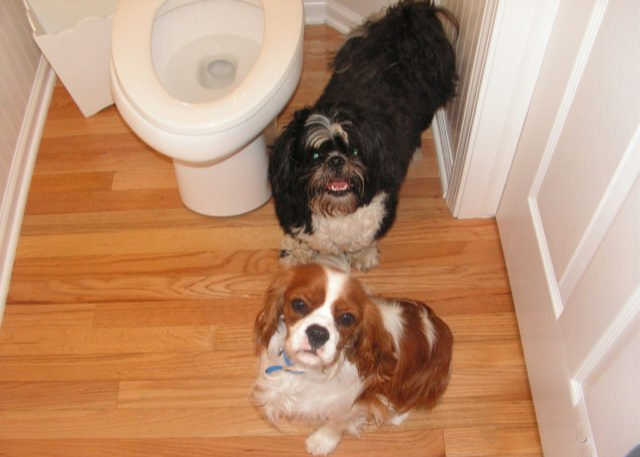
This is especially true when you first bring home a new dog — whether it’s an adult dog or just a puppy.
Yes, even older adult dogs that were once housebroken will occasionally have accidents in the house:
- If it’s happening with an adult dog that you’ve recently adopted, it is probably due to the new surroundings, strange sounds & smells, and the change to their daily routine.
- If it’s happening with an older dog that was once housebroken, then it might be due to a number of factors associated with old age.
Must read: How To House Train An Adult Dog
Don’t get too frustrated… you can easily train your dog to go potty outside by using the following tips!
What Is Your Dog’s Daily Routine?
When housebreaking a dog, remember that all dogs need to go outside at these times:
- After eating
- After playing hard
- After drinking a lot of water
- After getting up in the morning
- Before you leave them alone in the house
- Before going to bed at night
Does Your Dog Keep Having Accidents In The House?
If your dog is peeing or pooping inside your house, your first priority is to see if there is a pattern to their behavior.
Keep a notepad handy and take notes of what you were doing and where you were going when your dog went potty inside the house.
More importantly… What was your dog doing? How was your dog behaving moments before going potty in the house?
The best way to house train a dog is to establish a pattern to your dog’s behavior. You need to determine what (specifically) the trigger is that leads your dog to potty inside the house.
Once you have a better idea of what that is, then use the following housebreaking tips to put an end to ‘accidents’ once and for all!
Top 7 Reasons Dogs Potty In The House (…And What You Can Do)
There are several reasons that a dog may potty inside the house.
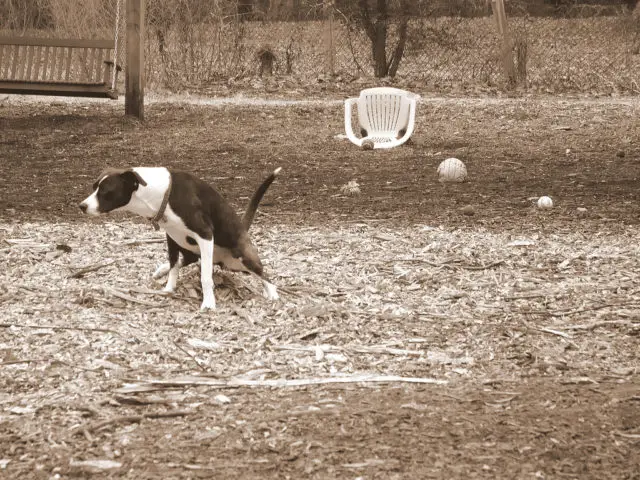
First, find the primary “issue” that you notice with your dog below. Then, click to find the best tips to house train a dog with that specific issue:
- Doesn’t like rain – Your dog may not like going outside on a rainy day and getting his paws wet, so he’ll go inside instead.
- Separation anxiety – If your dog barks like mad when you leave or you notice that the immediately potties right after you leave the house, then your dog may have separation anxiety.
- Never been potty trained – Maybe you got your dog as an adult, and he simply hasn’t been potty trained before. This is comment with dogs that spend most of their time outdoors.
- Submissive urination – If your dog is the nervous type and cowers at times (when you get near him, when he’s startled, when he hears a loud noise, etc), urinating in the house could be a sign of that nervousness.
- Marking their territory – Lots of dogs (especially dominant ones) tend to mark the places they’ve been as a means of claiming their territory.
- Excited to see people – Your dog may find it hard to relax whenever you or anyone else gets close to them. (This is a form of submissive urination.)
- Medical issues – It could be a health issue that is causing your dog’s inability to control their bladder — like diabetes, bladder infection, urinary tract infection, bladder stones, kidney or liver disease, tumors, adrenal gland issues, intestinal parasites, etc. Only a veterinarian can determine if your dog’s potty accidents are the result of health issues.
All of those are very different (and also very legitimate) reasons for a dog to potty inside the house.
First, think about the type of behavior that your dog usually displays prior to peeing or pooping in the house. Then, follow the specific instructions for the “issue” listed above to modify your dog’s behavior and get them house trained in no time!
Still need more help house training your dog?… Here are all of our best tips for potty training a dog.
My Experience With Dog Potty Accidents
I have 2 min pins, and we still have a few problems with one of them going potty in the house.
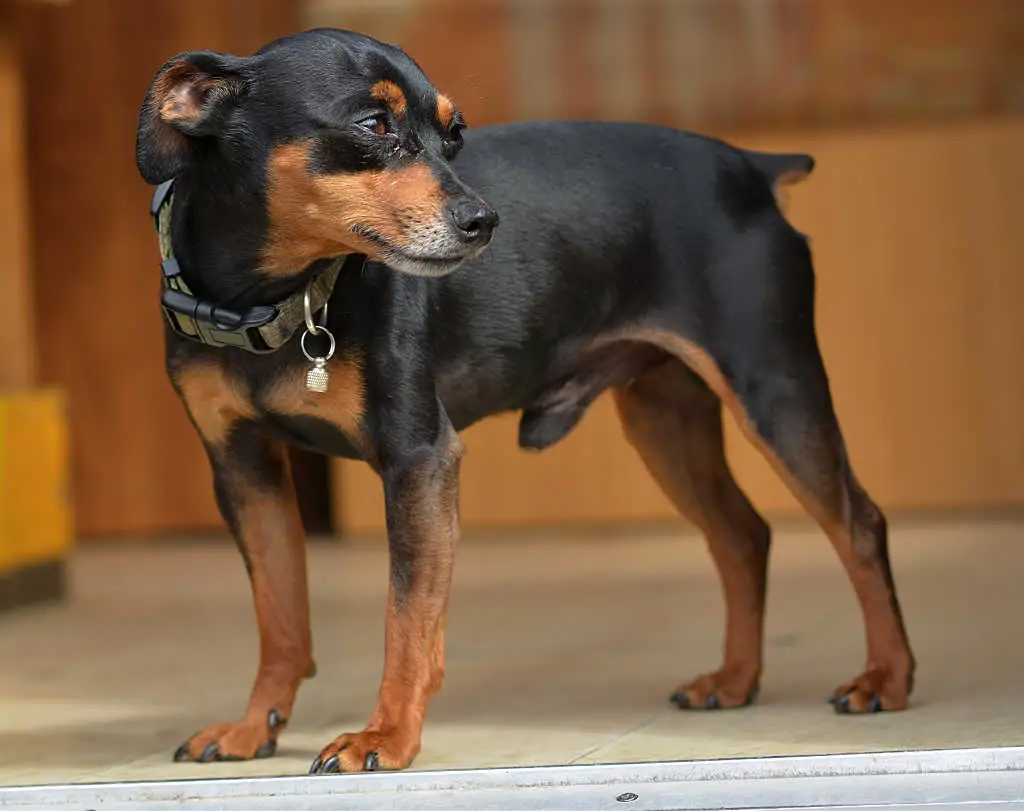
She will be 3 years old this year, and we are unable to trust her outside of her crate while we are at work.
We noticed the following pattern with our dog:
- When we give her full access to the house, we always return to find that she’s had an accident.
- However, if we confine her to the kitchen, we are less likely to come home to an accident.
I’ve just started to trust her being left alone in the kitchen when I go out for short periods of time — like to the grocery store. So far so good.
We believe that when she goes outside with her sister, she simply forgets what she is going outside for. She’s more interested in playing than going potty.
We determined this after routinely watching our both of our dogs’ behavior. For example, after having them both come inside, about 10 minutes later she would always ring her bell to go back outside. I watched her one day after she rang her bell — and sure enough, she went potty outside.
When we’re home, she never potties in the house. It’s just when we’re gone for long periods of time that the accidents sometimes happen. Fortunately, she seems to be getting better when she’s confined to the kitchen for short times. For longer times, we still keep her in her crate.
5 Dog Products That Help Tremendously With Potty Training
There are lots of helpful items you can use to assist you in keeping your house accident-free.
Here are the ones I like best because I’ve seen them be used successfully:
#1 – I know a lot of people who use piddle pads. I personally tried using them a couple of times with my min pins, but they refused to potty on them. Instead, they would just shred the pad. Other friends of mine have had great success with piddle pads.
#2 – You could always have a corner of a room that “seems” like the outdoors, but isn’t. This is what a lot of apartment renters do — especially people living on upper levels with balconies. Once dogs have been trained to use fake grass mats that look and feel similar to real grass (instead of going outside), they will quickly make it a habit to go potty on them.
#3 – One of my friends trained her dog to use a litter box, just like a cat. There are dog litter boxes of all shapes and sizes that you can train your dog to use.
#4 – We taught our dogs to ring a dog doorbell to let us know when they have to go outside. To train them how to use the bell the first time, whenever we thought they had to go outside, we would tap the dog bell with their paw. After doing this several times for them (each time before we took them outside), they eventually started to ring the bell themselves to let us know when they had to go outside. As with every other training scenario, after they did their business outside we would then praise them and give them a treat.
#5 – We also used a crate to help potty train our dogs. Any time we left the house, we made sure the dogs went inside their crates. That way, when we came home we didn’t have to look for accidents. As soon as we got home, we let the dogs go outside to go potty and get some exercise. One great thing about crate training is dogs usually won’t soil the place where they sleep.
TIP: Even if you didn’t start crate training your dog as a puppy, you can still crate train an adult dog.
Like this post? Save it to read again later… or share with others on Pinterest!