Bringing home a new ball of fluff is one of the absolute best feelings in the world. But let’s be real for a second—it takes about 3 seconds of a puppy chewing on your favorite shoes or turning your rug into a bathroom to realize, “Oh boy, we need a game plan!”
If you are currently sitting on the floor with an 8-week-old land shark, don’t panic. You don’t have to wait until they are older to start building good habits. In fact, starting early is the ultimate secret weapon for raising a chill, well-behaved dog.
Here is your laid-back, stress-free guide to surviving the first few weeks with a new puppy + How to teach your pup the basic commands they actually need to know right out of the gate.
Puppy Training 101
I’m not asking you to set up a training session as soon as you walk through the door — because your puppy will be far more interested in their new home than learning something new.
But once they have settled, you should start some short training sessions focusing on very important basic dog commands.
A common myth floating around is that puppies are too young to train at 8 weeks old. Total nonsense! While their attention spans are roughly the size of a single piece of kibble, their little brains are like sponges!
The trick at this age isn’t perfection. It’s about making training feel like a fun game. Keep your sessions incredibly short — 2 to 3 minutes at a time — and always wrap things up while they are still having fun.
Before we dive into the commands, remember the Golden Rule of puppy training: Positive reinforcement wins every single time. Keep a stash of high-value, tiny treats handy. When they do what you want, shower them with praise and a treat instantly. If they mess up, skip the yelling, ignore the bad behavior, and redirect them.
So which dog training commands should you concentrate on first?
And how do you teach those commands to a cheeky puppy who is far more interested in running around with your slipper in their mouth?
Start here…
Basic Puppy Training Commands
Following are the 5 most important dog commands you should begin teaching your puppy right away.
For each of these basic dog commands, you will guide your pup to where you want them to be.
There is room for error — which means they can (and will) succeed, at their own pace.
You simply offer praise and reward regularly, and your new puppy learns that training is actually lots of fun!
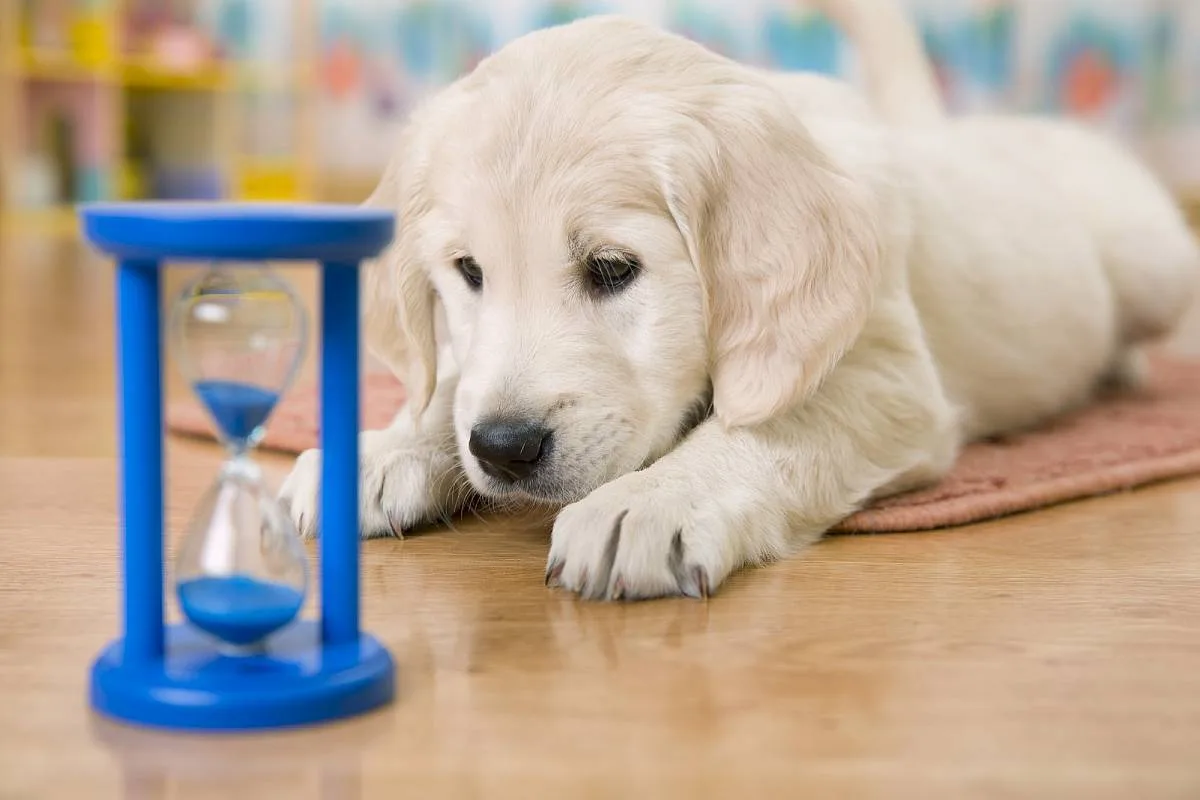
“The Name Game“
Before your pup can follow a command, they need to actually lock eyes with you when you speak.
How to teach a puppy to “pay attention” to you:
- Sit on the floor with your pup.
- Say their name in a happy, excited voice.
- The exact second they look at your face, say “Yes!” and hand over a treat.
- Repeat this a dozen times a day until they whip their head around every time they hear their name.
Advanced Tip:
Dogs are always thinking about whatever they’re LOOKING at. So, if your puppy isn’t looking at you, you can bet they aren’t thinking about you OR what you want them to do either. So be sure not to move on to the other puppy training commands until you’ve mastered this one: Getting your dog to look at you (I mean stare at you) without stopping.
“Sit“
“Sit” is possibly the easiest command for puppies, because sitting is a very natural position for a dog to be in. It’s also the universal “Please?” sign of the dog world AND the easiest way to stop them from jumping up on guests or your counters. You teach it with a lure (a dog treat).
How to teach your puppy the “Sit” command:
- Start with your puppy in front of you, while holding a dog treat in your hand. (They’ve likely already smelled the treat, so will be focusing on that!)
- Hold the treat in front of your pup’s nose and guide it back over their head. They will follow the treat and as their head moves back, their back end will automatically touch the ground.
- Praise and reward your puppy.
- Repeat — and as your pup’s back end touches the ground, label the behavior “Sit!”
- Repeat several times.
A puppy quickly learns that when their bottom touches the ground, something good happens — so they want to do it more!
Advanced Tip:
Be patient — because puppies don’t always sit still the first few times. Once your puppy sits long enough for you to label the behavior and say the command “Sit,” reward them. If you do this often enough, your puppy will quickly learn to sit and wait patiently on command.
“Lie Down“
An even easier command to teach a young puppy is “Lie Down.” Again, this is trained with a lure (treat).
How to teach a puppy the “Lie Down” command:
- Ask your pup to sit.
- With a dog treat in front of your dog’s nose, guide their nose to the ground and pull it out in front of them.
- They will instinctively lay down to follow the treat with their mouth (because that’s where treats go, right?!).
- As soon as your dog is lying down, praise them and reward with a treat.
- Repeat regularly, and your puppy will soon be lying down on command.
Advanced Tip:
To develop this command further, once your pup has been trained to “lie down” from command… as you say it, you could point down to the floor with a finger or demonstrate a hand movement. They will soon associate the command with the hand movement. That way, even from a distance, as long as you have your puppy’s attention, you could ask them to lie down without saying a word! Cool huh?
“Leave It“
The “Leave It” command can be a lifesaver! Puppies explore the world with their mouths, which means they will try to eat literally everything on the floor — from your dropped socks to wild mushrooms in the yard. What if you’re walking on the sidewalk and find takeout food from the night before has fallen from someone’s garbage bin? Things like onions, chocolate, and grapes are not your dog’s friend. (By the way, here’s a list of human foods that ARE safe for dogs, and foods that are NOT safe for dogs to eat.)
How to teach your puppy the “Leave It” command:
- With a treat in your hand, close your fist around it.
- Hold it in front of your pup’s nose. They will likely sniff, nuzzle and paw at you to open your hand. Don’t.
- As soon as they ignore it or turn away, praise them and give them the treat. The idea is for your puppy to learn, that if they ignore a good thing, something good happens anyway.
- Repeat.
- Once they’re getting quicker at ignoring, label the behavior “Leave” as your pup turns away. Then praise and reward them.
Advanced Tip:
You can progress to leaving a treat on the floor and asking your puppy to “leave it”, or even asking them to leave their food when you first place it down in the bowl. Just make sure your pup already has a full grasp of the next command (“Release” / “OK”) first — because they need to know when they CAN eat!
“Okay“
Teaching a release word (like “Okay”) is important because your dog should always learn to wait for “permission” from you before being allowed to turn their attention somewhere else. Many dog owners choose “OK!” as their release word. Some use the word “Free!” The command is entirely up to you… it’s the behavior we are concerned with.
How to teach a puppy the release command “Okay”:
- Standing next to your dog (in a sit, down, or just stood position), throw a dog treat in front of them.
- As soon as your pup steps to eat it, use the command (“Okay”) to label the behavior that they have your permission to go get it.
- Repeat.
- You should work to the stage that your pup focuses on you, you say the “okay” command, your pup releases, and THEN you throw the treat.
Advanced Tip:
Instead of saying “Okay” every single time, include a couple of “Nuh-uh” moments as well. This will remind your dog that sometimes they will have to wait just a teeny-tiny bit longer for the release command. When you catch your pup in the act of moving forward to get the treat, sternly say “Nuh-uh” and shake your head in disapproval. If they wait even a few seconds longer, then quickly say “Okay”.
“Come“
This is the single most important safety command you will ever teach your dog. A rock-solid recall (“Come!”) can literally save your pup’s life if they ever slip out of their collar or bolt through an open door. Coming TO you rather than running FROM you is important when it comes to keeping your dog safe.
How to teach your puppy the recall command “Come”:
- With a young puppy, you literally start by simply saying their name and “Come!”
- Then give a treat — even if the dog is directly in front of you. The point is to reward them for paying close attention to you.
- Repeat.
Advanced Tip:
As your puppy gets older, you’ll want to call them from a distance away — use a high-pitched voice, and act excited to get their attention. As soon as your pup gets to you, reward them. Then repeat again. Working with distractions and distance when your puppy is older will solidify their skills with this command. This is a very important command to master early — in case they ever decide to wander off on their own!
The Bottom Line
While you may not think there are many commands here, that’s sort of the point! You don’t want to overload your puppy. Just work on 1 basic dog command for 1 week, and see how it goes.
Spend no longer than 15 minutes a day on these dog training commands — especially at such a young age. Any longer and your puppy will get bored… or tired! It’s important that your puppy is 100% focused on the activity at hand.
If your dog is getting distracted, then end the training session on a positive note by requesting something of your puppy that you know they can do. It will be much easier to entice your pup into the NEXT training session if they know that good things always happen during training!
After it’s clear that your puppy has learned these important commands, you can begin to phase out the food rewards. You can still give treats occasionally as a reward, but you don’t necessarily want your puppy to expect food rewards every time you give basic dog commands. Once they understand a command, sometimes give treats and praise, and other times just give lots of praise and excited play time as a reward.
3 Easy Ways To Avoid The “New Puppy” Burnout
Training a puppy can be exhausting, but keeping these 3 real-world tips in mind will keep you from pulling your hair out:
- Ditch the Food Bowl – Instead of feeding your pup 2 big meals in a standard bowl, use their daily kibble allowance as training rewards throughout the day. It turns mealtime into a mental workout and keeps them from getting stuffed on too many extra treats.
- Capture the Good Behavior – We tend to only pay attention to puppies when they’re doing something wrong. Flip the script! If you see your pup quietly chewing on a designated toy or laying calmly on their bed, walk over, quietly slip them a treat, and say “Good boy/girl.” Reward the peace you want to see.
- Manage Your Expectations – There will be days where your puppy acts like a total genius, and days where they look at you like they’ve never heard a single word of English in their life. It’s totally normal. Take a deep breath, put the treats away, and try again later. They’re just babies!
READ NEXT: 21 Clever Ways To Save Money Every Day When You Have A Dog
Like this post? Save it to read again later… or share with others on Pinterest!
Our guest contributor, John, is the founder of All Things Dogs. He’s a member of the Association of Professional Dog Trainers, a graduate in Animal Behavior and Welfare, and a recognized author by the Dog Writers Association of America.