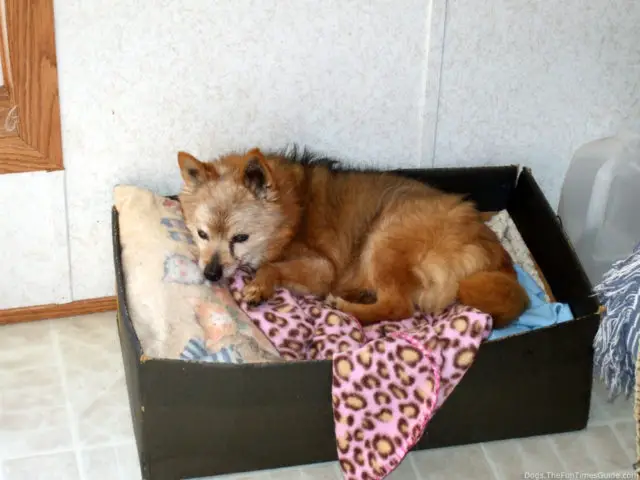
 When it comes to problems experienced by aging dogs, our dog Rascal has most of them.
Though he is still in reasonably good health and not suffering from many aches and pains, his navigational skills have been reduced to what he can smell.
With doggie cataracts and hearing loss that has eliminated most of our ability to communicate with him, Rascal still seems to get around the house with little trouble.
He definitely relies on his nose a lot more now. He uses smells to reassure himself that he’s on the correct or intended path.
Yes, our old dog has slowed down a lot, but he’s still the same old Rascal to us.
No longer does he run about the house like he used to.
Instead, he sleeps away most of the day.
The Nose Knows
When he does decide to take a stroll, it’s at a slow determined pace — with his nose pointed straight out. He uses his nose as a blind person would use a cane; walking slowly enough that when he bumps into something it’s at such a slow speed that no damage is done.
That’s the only way that Rascal can recognize when something is in his way. Like a windup toy that is designed to spin and go another way, he will simply alter course and continue on.
It’s such a common occurrence that it can even be somewhat comical at times. For example, if Rascal manages to get under the dining room table with 6 chairs, he can spend up to a half hour bumping into different chair legs while trying to find his way back into open space. There’s no pain, I assure you. It’s simply Rascal’s way of navigating his world these days.
When Your Old Dog Can’t Hear You
Calling our aging dog by name is a waste of time. Thankfully, he still responds to a sharp noise, like the sound created by clapping your hands together.
When we let him out onto the deck to get some air, finding the door to come back in is difficult for him. But if I snap my hands together a couple times, he can usually get his bearings and find his way to the door.
Surprisingly, it took very little effort to train this old deaf dog to respond to certain sounds. He learned rather quickly what is meant to help him get by.
Must Read: Dog owners share their tips for living with a deaf dog.
Old Dogs Are More Sensitive
 Old dogs can easily become insecure. Whether it’s from his diminished senses, or maybe his mental capacity is slipping as well, I don’t know.
I do notice that when using his nose to navigate, he will come up and bump his nose against our legs — just to reassure himself that we are close by.
And his nose goes up and he starts sniffing the air whenever we are eating, because he still wants his share of any treats that might be getting passed around.
I make it a point to pick him up and snuggle him, while talking to him with the side of my cheek against him. He may not hear the words, but the vibration tells him the tone of voice I’m using. This way, he knows that I’m comforting him and all is good.
Setting Boundaries For An Old Dog
Adjusting to a blind and deaf dog really has taken very little effort.
Naturally, we can no longer turn him loose in the yard. When he still had partial sight, we would watch him in the yard as he set his own boundaries to define his space. Our yard is enclosed by concrete sidewalk, and he knew as long as he was inside the sidewalk space and never stepped down off the curb he would most likely be in our yard.
Occasionally, he would manage to get to our neighbor’s porch instead of ours (a very short distance). But since we would be watching him very closely, it was only a simple matter of retrieving him.
Even old dogs like to feel they have some freedom and ability to get by on their own. Like humans, giving up that last bit of independence is something they really don’t want to do.
Fortunately, Rascal’s navigational problems have advanced to the point now that he is more than willing to turn over the reins to us. He is totally dependent on use now, and he is quite happy to have it so. It’s just one less thing for him to worry about.