 A visitor to this site recently emailed me this question:
I have rescued a puppy and she is a spoiled rotten brat, and she won’t quit peeing on my carpet. What can I do? I’ve tried kenneling her and she gets out everytime. Thank you. — Linda T.
Here are my recommendations…
First, I would ask how she “gets out every time” you kennel her.
With a proper lock on the kennel door, this shouldn’t be an issue. Are you using a homemade kennel, by chance? Either way, that’s your first step… secure the kennel shut.
Also, make sure there is enough room inside the kennel for her to move around — from end to end — and fully turn around inside. (More tips for using dog crates here and here.)
The puppy sleeps in the crate, period. No cuddling in bed, no wandering the house at night when I can’t pay attention. They sleep in their crates for roughly 8 months, through periods of housebreaking, chewing, and manic puppy play. Only when they are housebroken, past their teething, and able to sleep calmly for substantial periods do they get to choose between the crate and other spots in the house — including my bed. ~Katz on Dogs
Now, let’s talk about some ways to stop a dog from peeing on the carpet…
2 Ways To Stop A Dog From Peeing In The House
#1 – Stick to a peeing & pooping schedule.
The most important thing is to get your dog used to a schedule.
In the beginning days, it will be the dog’s own schedule that you must adapt to — whenever they’ve gotta go, they’ve gotta go. There’s no time to second-guess “does that mean she has to go outside or not?” Instead, always error on the side of caution and presume that ANY sign from your dog means she’s got to go relieve herself.
This can be quite frustrating in the early days, because you’ll be wrong half the time. And, it consumes a lot of your time when you have to keep your eyes glued on your dog every minute of the day.
Plus, your dog will quickly learn that she can “signal” to get your attention pretty much any time she wants to.
Nevertheless, in those first few weeks, every signal should be interpreted as a sign to go outside. Over time, you and your dog will begin to fine-tune those signals together. Don’t worry about it, or try to over-think it. This will all come naturally as you and your dog learn to communicate together — as long as you are 100% consistent and never show your frustration or anger with her in any way.
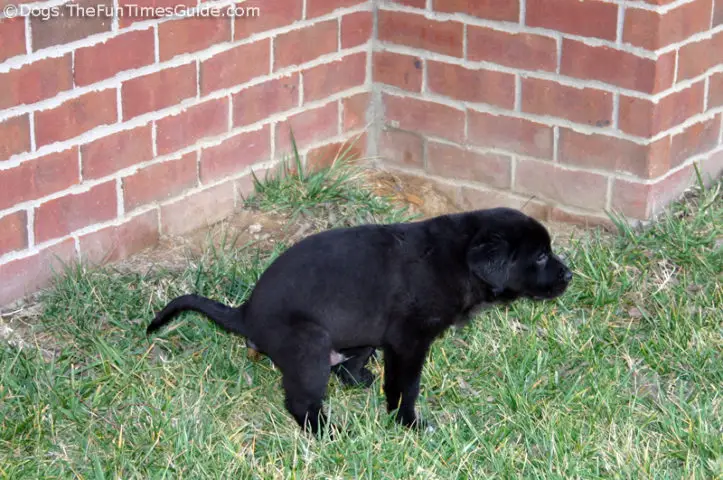
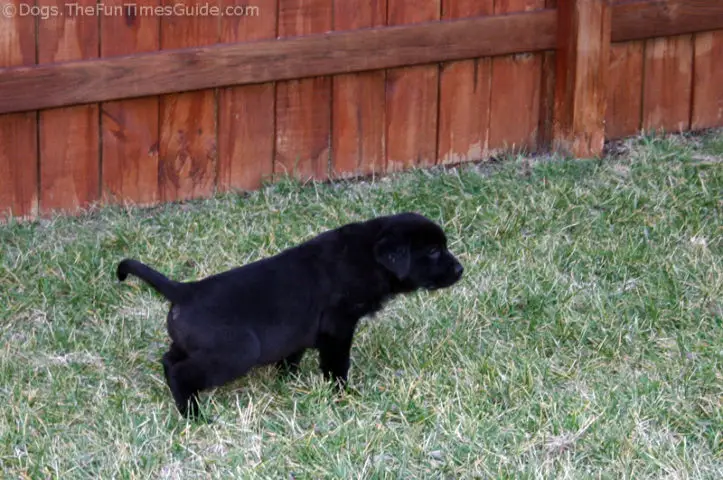
Typically, dogs need to relieve themselves at these times:
- Immediately after they wake up (this includes mornings and any naps)
- After opening the door of the crate that they’ve been in for awhile
- After every meal
- After any rambunctious play time
- After they’ve ingested a lot of water
- Right before bedtime
- Immediately after they wake up in the middle of the night (yes, late night walks are required)
 As for the timing of “after every meal”, we always took our puppies out 20 minutes after they ate. Any less than that, and they didn’t have to go to the bathroom yet. Any longer than that, and we’d quickly discover that we waited too long (they usually went in the house). But your dog may be on the 10-minute or 15-minute timeframe after eating… you’ll figure this out right away.
#2 – Ignore the mistakes, praise the successes.
Another very important factor in your dog’s housetraining success: rewards and praise!
Every single time your dog squats, pees, or even looks like she is attempting to relieve herself outside, you should give her tons of praise. This includes lots of high-pitched praise, puppy-talk, and smiles. Your dog picks up on these things.
Also, if at all possible, always give your dog a tiny treat whenever she relieves herself outside. Finally, your dog deserves lots of hugs and kisses with every successful elimination outdoors. You should do all this until your dog truly “gets it”. This means every single time for the next several weeks… or months.

As a general rule, a puppy can only hold his waste for the same number of hours that he is old, in months. In other words, a four-month-old pup should not be left alone during the day longer than four consecutive hours without an opportunity to go outside. By the time the pup is four months old, he should be able to make it through the night without going outside. — ASPCA
Some Things To Try
 I know a bunch of dog owners who’ve had tremendous luck with housetraining pads — otherwise known as “piddle pads”.
Some people use these both indoor and out, say for teacup chihuahuas. Especially when they travel. When that’s all they’re used to peeing on, they sometimes won’t go on the grass or anything else!
 Others use indoor dog potties, like the UGODOG indoor pet potty and the wizdog indoor dog potty.
With these, you don’t need to buy refills, there are no messy dog tracks, and nothing shreds and gets messy.
Think: a litter box for dogs… but cleaner!
Tips For Housetraining A Dog
- What to do and what not to do — according to dog experts at the ASPCA.
- 6 sure-fire tips to housetrain in one week — simple and to-the-point, these are the most basic steps to housebreaking a dog.
- Paper training a puppy without ruining your floor and staining your carpet — here are some basic guidelines for paper training a puppy using old newspapers you already have on hand.
- Housetraining puppies and retraining adult dogs — a multi-part article from Animal Planet that covers every aspect of house training dogs of all ages.
- How to remove dog urine stains & odors — tried & true ways to keep the stains and odors from taking over your entire house.
What About When You Catch Your Dog In The Act?
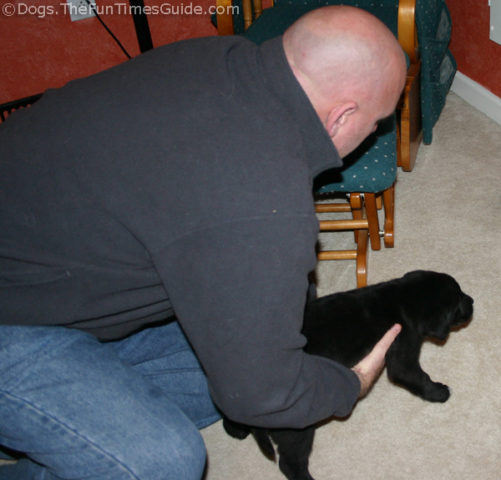 Some people shout “No!” very assertively right away.
Others simply clap their hands and the loud noise will startle the dog stopping her from peeing at that moment.
Either way, quickly take your dog outside to finish her business. And you clean up the mess later.
Never scold your dog for making a mess indoors. Other than a forceful “No!” at the very moment you catch her in the act, any scolding after that would not be effective at all. Dogs do not associate prior actions with current scoldings… ever. They just think you’re being angry and mean for no reason. (Even if you rub their nose in it… they just don’t get it. So please don’t do it!)
The key is to be firm and consistent, while you learn to potty train a dog, reward them for good behavior. Soon you will find that they are getting the idea and start telling you when they need to go outside. When they do start letting you know, make sure you are watching and let them out right away, or you may find yourself back at square one. Source

Helpful Resources For Housetraining Dogs
 Happy Housetraining: Train Your Dog Easily & Effectively — an ebook that’s very well respected by Gene Sower.
- Questions & Answers On Housebreaking — a FAQ from dog expert Ed Frawley who writes: “I may often come across as a little on the blunt side, (some may call it brash). That is because I consider myself an advocate for dogs and not dog handlers. I am an advocate for common sense dog training and not the latest fad that appears on the horizon.”
Dogs Learn How To Pee & Poop From Other Dogs
If you have more than one dog, then your task of housebreaking a new dog should be a bit easier. This includes learning where to go to the bathroom and how to go to the bathroom.
Why?
Because dogs typically mimic what they see other dogs doing. (But not always.)
These pictures show our youngest male puppy watching closely as the adult male dogs teach him a few things about pooping and peeing:
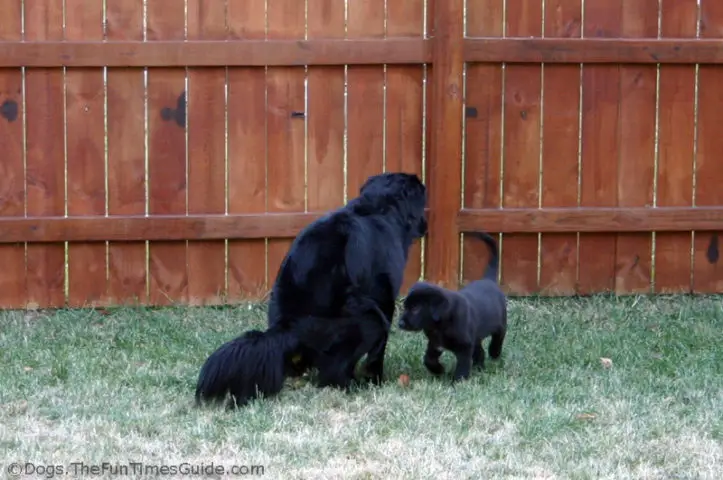

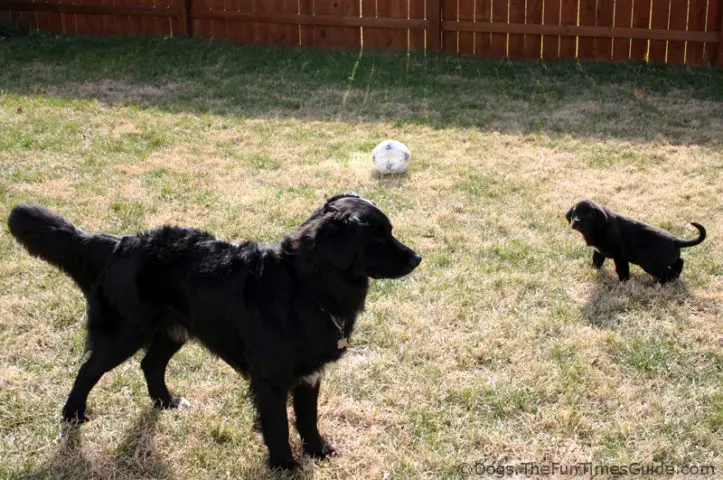
That said, if your dog was removed from the litter (and more importantly, removed from its mother) at too young an age, then your dog may not have properly learned the basics of urination.
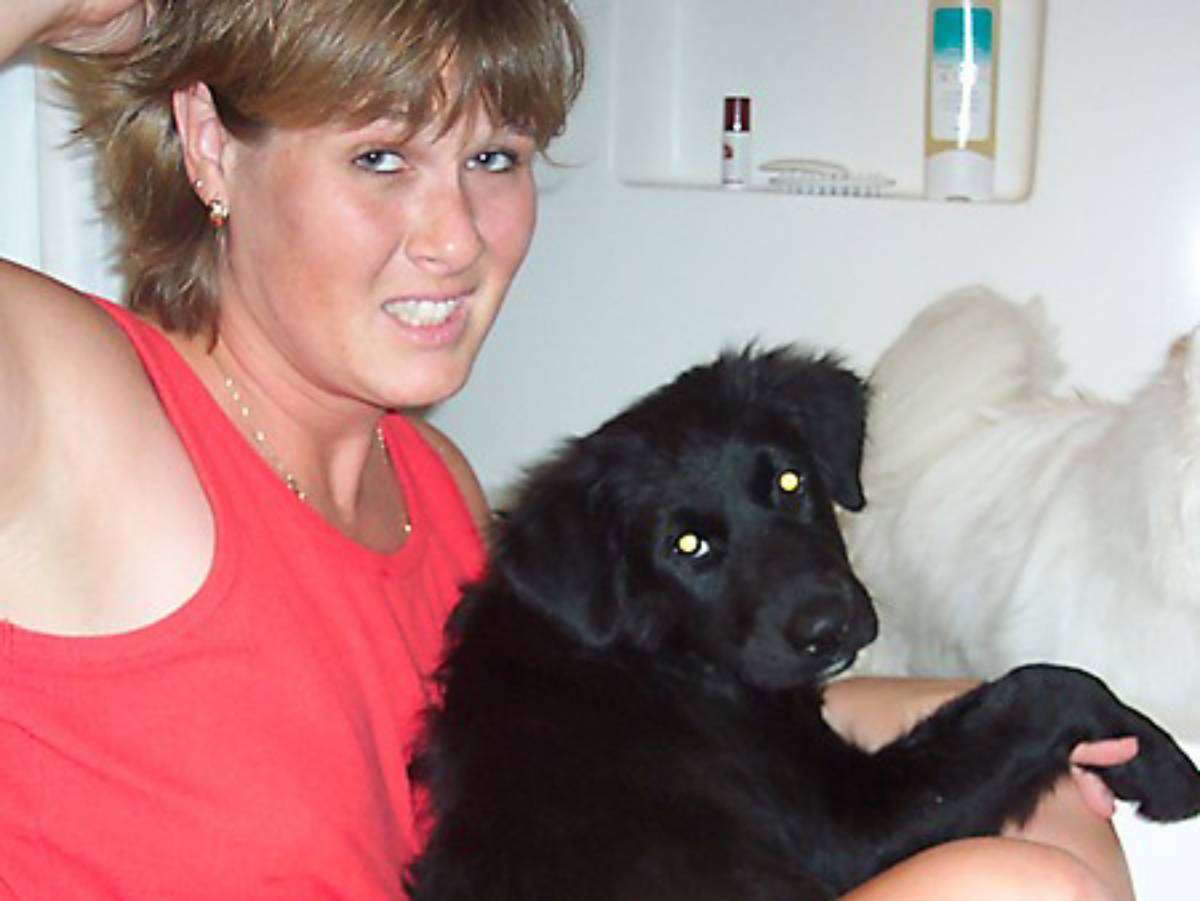
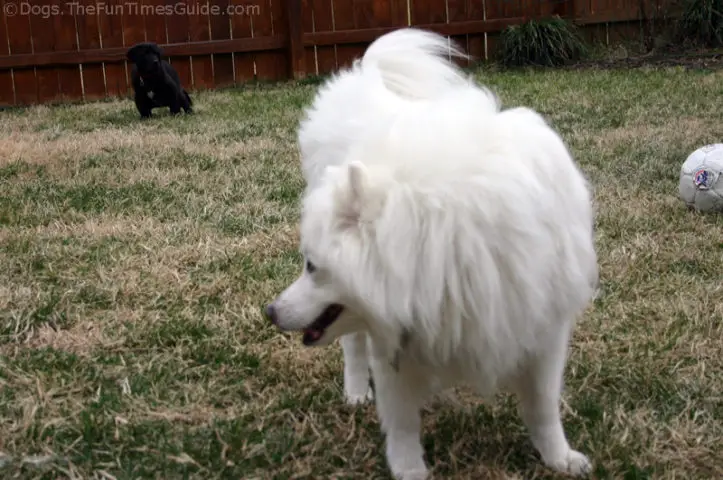
This happened to my American Eskimo (the white adult dog in the photo). I got him at 7 weeks of age — which is a little too young for a puppy to be removed from its mother. You should wait until the puppy is at least 8 weeks of age. Better yet, you’ll give your puppy a head start in life if you wait until 9-12 weeks of age before removing him from his mother.
UPDATE: I recently learned about another thing that could cause an adult dog to start peeing in the house — even after years of successfully urinating outside:
A spayed female dog who becomes incontinent at a fairly young age is usually the result of an estrogen deficiency. Normalizing the estrogen level may resolve the incontinence. Source
In my opinion, the link between spaying / neutering and dog behavior issues is eye-opening! It’s definitely worth considering how the lack of hormones affects a young dog.