If you’ve already got one dog and you plan on bringing another dog into your home, there are a few things you should know.
First, you should probably familiarize yourself with the dog pack hierarchy.
That way, you will have a better understanding of your dogs’ behaviors and the way they interact with one another.
After that, there are a few things you can do to ease the process of introducing your dogs to one another, while at the same time fostering your love for each of them individually.
Following are some quick tips for raising happy dogs in a multi-dog household.
Each Dog Should Have Its Own…
#1 – Sleeping Area
Whether that be a dog pillow, a crate, or a separate room, each dog should have their own personal and private place where they can retreat and be alone whenever they want to — and whenever you need them to.
TIP: We crate train each of our dogs until they are housebroken. (Actually, it’s usually closer to when they turn one year of age — when we can fully trust them to roam alone in the house). After that, each dog gets their own dog pillow. Now, when we tell our dogs to “go to bed” at night, each dog rushes to their respective pillow. (Okay, one dog has since given up the pillow for the cool linoleum floor in the adjoining bathroom. And the other, the largest, has completely monopolized our bed. But you get the idea. The little puppy still enjoys his pillow at night! The other two dogs use their pillows more as napping places during daytime hours.)

Dogs need to have their own “space,” which is why I am a proponent of crates: especially for multi-dog households. Even if you are planning on allowing the dogs to sleep outside of their crates or have the run of the home when you are away, crates are useful when dogs need a little “alone time.” It’s a good idea to start to condition your current dog to being alone in the crate with Kongs or other “food toys” so they start to get the idea that things can be good when they are alone. If you are really dead set against using crates, set aside rooms or areas blocked off with baby gates or exercise pens.
—Dogtime
More about this: How To Teach Your Dog To Sleep In A Specific Place
#2 – Dog Toys
The day you bring a new dog into your home, you should also bring home a couple of brand new (never before played with by other dogs) toys as well. Give these to the older dog to sniff and approve first. In a short time, that dog will “allow” your new dog to play with these dog toys on their own — especially since these were never his toys to begin with. Chances are, the older dog won’t even be interested in the new toys because age-appropriate puppy toys will likely bore an older dog. Watch for resource guarding behaviors by the older dog. (Here are some tips to prevent resource guarding in a multi-dog household.)
TIP: With “treat toys” (like Kongs), which combine playing with eating, always have a separate toy of this type for each dog in the house. Otherwise, you could face some food aggression during play time — which will likely get worse over time.
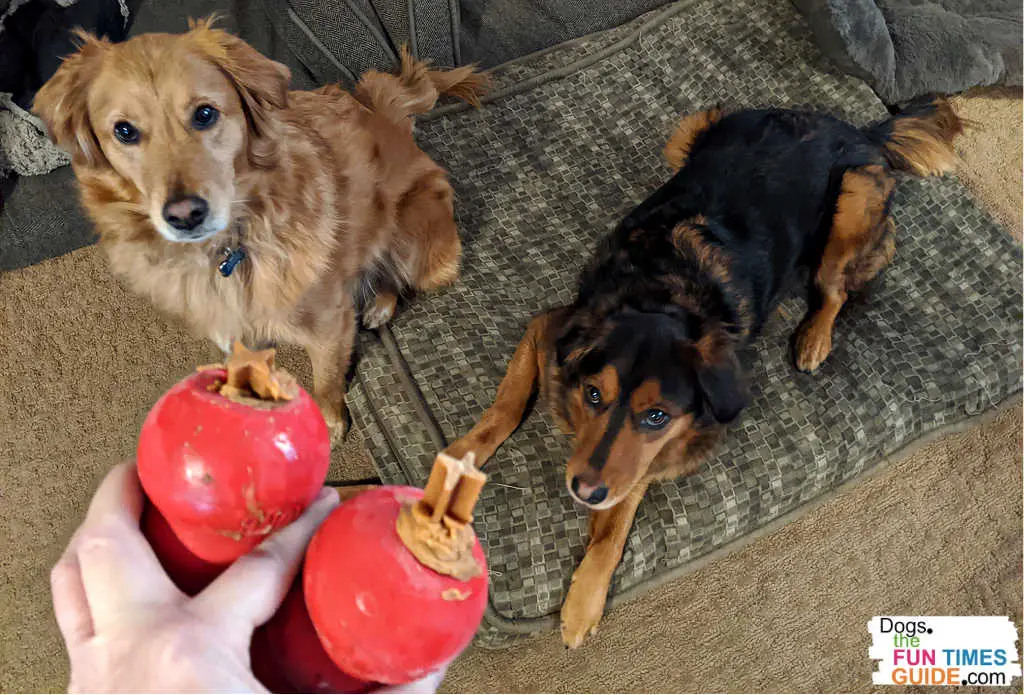
Be proactive by teaching your dog to “drop it” and “take it.” This teaches a dog to give things to you and not claim them for their own.
—Kate’s Canines
More about this: What Can I Do About Dog Resource Guarding?
#3 – Food Bowls
To prevent food aggression from happening, dogs should have their food area and their own food bowls. Sometimes, it may be necessary to place one dog’s bowls in one room (like a bathroom) and the other dog’s bowls in a different room (another bathroom, bonus room, etc). Other times, it will be perfectly okay to keep them in the same room — just on opposite walls or something. All dogs are different. Our first dogs had to be completely separated while eating and their food stations were in different rooms. Our current dogs have no issues — as long as there’s a “community water bowl” in between their two food bowls. (We use this gravity-fed 2.5 gallon dog water bowl.)
TIP: From the first day a new dog enters your home, you should show them who’s boss when it comes to food! Pass your hands through the food pellets in his bowl while he’s eating to show him it’s okay for others to be in his food. Start doing this when your dog is a puppy, and continue this practice every few months throughout the life of your dog.
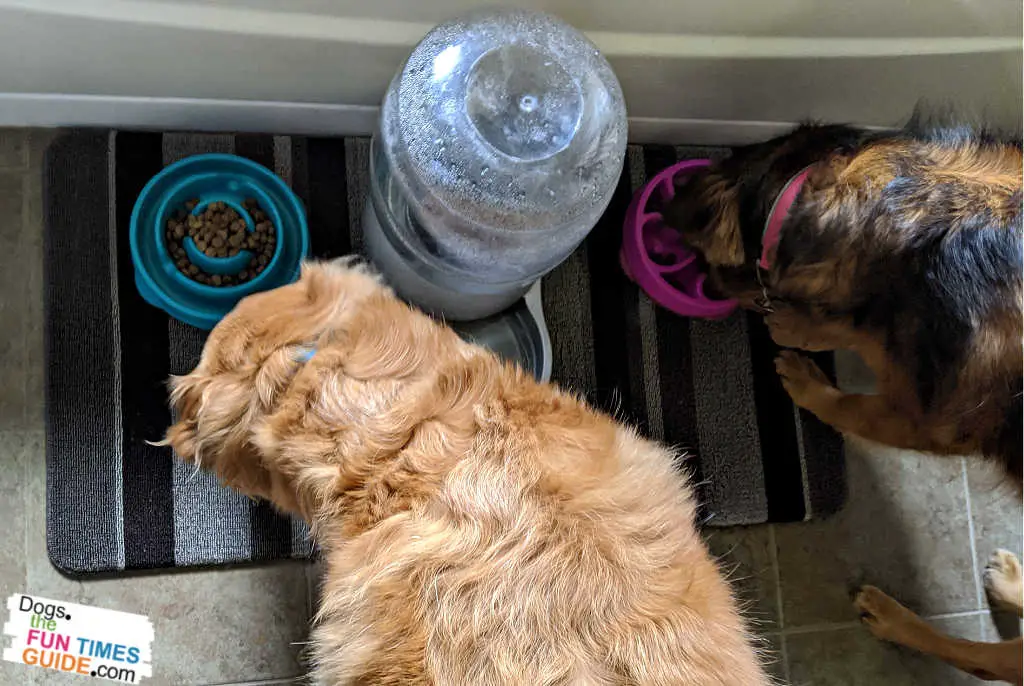
Separate them for all feeding, including treats and highly desirable toys. Dogs who would otherwise get along great can go into a survival mode over food. Don’t put them in this position.
—Veterinary Partners
More about this: Possessive Aggression In Dogs
Additional Tips For Raising Two Or More Dogs
In addition to the links I’ve included above, following are some additional resources that you will find helpful:
- All My Best Tips For Raising Two Dogs Together
- How To Tell Who’s The Boss In Your House?
- Raising Two Pups At The Same Time… Why It’s A Bad Idea
- Tips For Introducing Your Dog To Other Pets Or Animals
- What To Do If Your Older Dog Becomes Aggressive With Your Puppy
- Tips For Training Two Dogs At The Same Time
Like this post? Save it to read again later… or share with others on Pinterest!


I like to help Dog Parents find unique ways to do things that will save time & money — so I write about “outside the box” Dog Tips and Dog Hacks that most wouldn’t think of. I’m a lifelong dog owner — currently have 2 mixed breed Golden Aussies that we found abandoned on the side of the road as puppies. I’ve always trained my own dogs and help friends train theirs, as well. Professionally, I worked at a vet and have several friends who are veterinarians — whom I consult with regularly. (And just because I love animals so much, I also worked at a Zoo for awhile!) I’ve been sharing my best ideas with others by blogging full-time since 1998 (the same year that Google started… and before the days of Facebook and YouTube). My daily motivation is to help first-time dog owners be better prepared from the first day your new puppy enters your home. I like to help dog owners understand what’s ‘normal’ and what you can expect in terms of living with and training your dog — how to get through the ups & downs of potty training, chewing, teaching commands, getting your dog to listen, and everything else that takes place during that hectic first year! When I’m not training, walking, grooming, or making homemade treats for my dogs, you will find me at the corner of Good News & Fun Times as publisher of The Fun Times Guide (32 fun & helpful websites). To date, I’ve written over 600 articles for dog owners on this site! Many of them have upwards of 200K shares.